Translate

Saturday, June 25, 2016

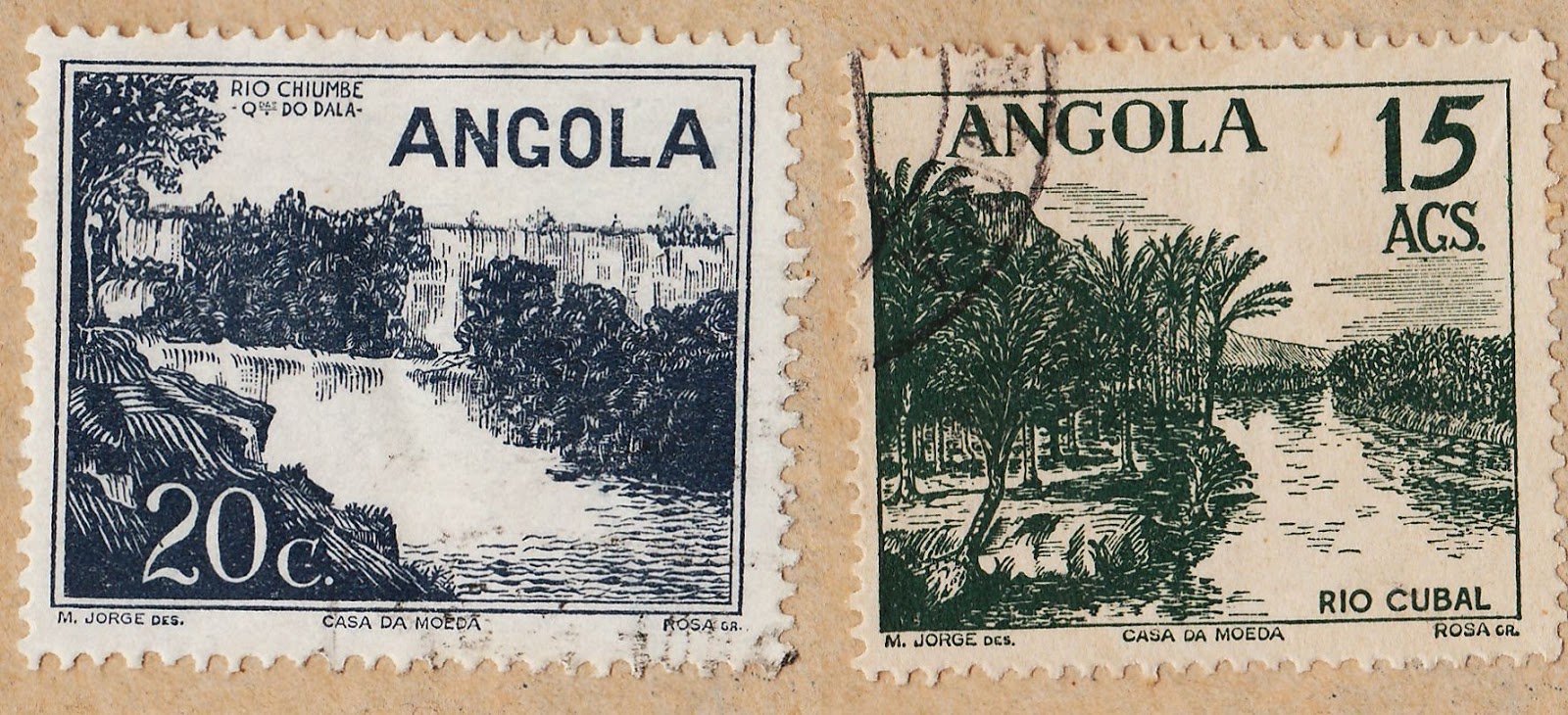
Angola (5th Post), Mozambique (2nd Post), Timor (1st Post)

New Entries

A Great number of my last posts are dedicated to a single country, with stamps of one or more periods of a country's Philately...today , I have a post with stamps from 3 countries and I decided to present them together because the stamps are from the Colonial Period of these countries, all under Portuguese Authority and influence...
It will be a brief and small post , where i will present 3 complete series, one for each country...none of these 3 series are rare but at the same time they are not easy to get in their complete form...many of the stamps from these countries are very common, specially those from the 50's and 60's but the pictorial stamps from the 30's and 40's are not so easy... I am still trying to get the Cape Verde and Macau's "Views" series , both from 1948...

Let us start with the "Sights and views" from Angola...


All these "Sights and views" series from 1948 are work of one of the Greatest Portuguese stamp designers... I'm talking about Alberto de Souza, that has many, many stamps for Portugal and many of them also for the Ex-colonies... the stamps are also engraved by several Artists , and are [Litho] printed ...
Lately I have made some remarks about the scans and the resolution we should use for each kind of printing.. with these Angola stamps, I've used the wrong resolution, with to much detail.. I should have used the 400ppp , that it is the adequate for these stamps ...there is the possibility of the existence of some slight differences in the colors, so if you could arrange some spare stamps , better (collecting different shades is always FUN..!)
All the information about these stamps and all the others from Angola, and all the Portuguese colonies are present in the "AFINSA Colónias" Catalog.. I am a avid user of stamp catalogs and I must say that both the Catalogs ("AFINSA PORTUGAL" and "AFINSA Colonias") are very good , with all the technical details, printings , designers , engravers, etc and even some historical remarks about the early classic emissions...Both are very detailed and are good and necessary acquisitions for the collector...
1948 "Sights and Views of Angola" (7) [Des (M. Jorge 20c,40c)(Alberto de Souza others)][Engr (José Rosa 20c)(Arnaldo Fragoso others except 40c/Mint)] [Litho] Sc(319,...,324)


The series has 20 stamps, with 10 different designs... there is not much to say about this series.. some of the stamps are really beautiful and they don't have the usual overall aspect of the Portuguese colonial stamps...Engraved stamps are not a common fact among the stamps made for the colonies and this is what make this group of series so special....
1948 "Sights and Views from Mozambique" (20) [Des (M. Jorge 2$50,10$,15$,20$) (Alberto de Souza  / others)][Engr (José Rosa 5c,30c)(Marcelino Norte 20c,40c)(Gustavo Araujo 60c, 1$75,3$,3$50)(Guilherme Santos 10c,1$20)(Americo Carvalho 1.50,2$,15$,20$)(Arnaldo Fragoso / others)][Litho (Casa Da Moeda)] Sc(305,...,324)


These are good examples of stamps that could not have been made in our days, in 2016... first , because the idea of a country having colonies is outrageous...in second , because stamps degrading the native woman in such a way are not possible and our Moral standards cannot comply to this view of things...however , I think that , as a collector, I should describe this series , only as "Indigenous People" and restrain myself of doing any other type of considerations...other day, I saw an article  about the Portuguese colonial stamps, and all the talking was about slavery and condemnation of  the traffic of slaves between continents... it is true that , with our eyes, "the eyes of the future" all of that was highly irregular, but I think that we should not , in any case, give our personal opinion about the History related in a stamp.. that is not the role of the collector.. We should not use stamps to give our personal opinion, and we should not mix things...A stamp is something made in a particular time frame , and we should use the ideas accepted in those days to understand the stamp and what it represents....nothing more!!! Don't forget that I am talking as a world Stamp Collector.. I cannot have barriers to my ultimate desire, that is to collect...what to say about Hitler's and the III Reich stamps?? should they be forgotten ?? why,?  the ideas behind them are the worst, but the stamps themselves, could be like many others ,beautiful and work of great Artists...should they be forgotten??? should We , World collectors, comply with these ideological barriers..?. NO, is my answer.. if we do not mix our opinion about the idea behind the stamp with the stamp itself, we are "immune" to this "Time Barrier"....for me, collecting Hitler's stamps or "Butterflies" stamps is just the same thing... only nice designs, possible good engravings, different papers and perforations, some nice colors...... stamps! 

Now , some considerations about these particular stamps are in order... I cannot keep from seeing that the printing is not the best... some stamps present a displacement of the colors or lack of detail, and that is something we are not costumed with Portuguese stamps... the usual [Litho] printing is in general a good one , and this is a bad example of those printings... 
1948 "Indigenous People" (8) [Des (Alberto de Souza)][Litho] Sc(246,...,253)


Next time i will have some Guatemala stamps..

Seeyou


Thursday, June 16, 2016

Brazil (3rd Post)

New Entries

I was thinking of doing some work with Israeli stamps, but at the last moment, I decided myself for the Brazilian ones...some of my first stamps were from Brazil but until now there was an enormous gap in my collection.. I didn't had any D. Pedro stamps...now that I've got some of them I really want to have many more, not only by the presence of a great amount of color shades, but also for the beautiful designs and at last by the work and influence, again, of ABNC...


These are 3 beautiful stamps from the D.Pedro II 1866/1868 series... the stamps of this series present several different frames, sometimes with the same vignette, as in these stamps...As I said above , the stamps were designed, engraved and printed by ABNC, New York, and this influence is very notorious... at the same time it increases the quality of the stamps, because in those days American stamps, were known to be very well printed...from the very detailed and well designed frame to the frame ornaments, everything seems to be very ABNC.  
My SG catalog has references of the existence of many shades of the Green 100r, but I don't know if there are also shades in the other values of the series... that's a future task for me , to buy some more spare stamps from some of these values to better understand and study this subject...in some cases, the stamps could be printed in a "blued" paper, and this fact increases a lot it's value... this only happens in the stamps until 100r , the high values , 200r and 500r , are excluded from this 'talk'...
to end this small presentation of this 1866 series , I need to talk about two small details...the first is the possible existence of two types of 100r stamps : 


I only have one of these stamps, so just one of the two types are presented... the leftmost top ornament has a very faint border (Type 1) or a clear double border line (type 2)...
This is clearly a type 1 stamp...


The 2nd is that in 1876/1877 a new series is printed with the same designs and values, but without a clear 12 perforation... this new series is rouletted , like the two following stamps...

1866/1868 "Emperor D. Pedro II" (7) [Des/Engr (ABNC,New York)][Recess (ABNC,New York)] Sc(53,56,58)


this is the rouletted series of 1878/1879 , presenting us an older Emperor with a clear white beard..I want to emphasize that  these two stamps are presented with different sizes, but we all know that the stamps are of the same size ( for those who are not experienced in scans , I could say that if we apply the same scan detail [600ppp in this case] to the two stamps separately , the final result will be different depending on the size of the background paper that appear [ the limits You define for the scan ] ; when I'm taking the scans I'm not thinking in joining them in a a solo image [but I should be!!], and this is unfortunately what happens!!!)
Another beautiful series with lots of different frames and even some different portraits...it is again work of ABNC,New York ...
1878/1879 "Emperor D. Pedro II" (10) [Des/Engr (ABNC,New York)][Recess (ABNC,New York)] Sc(72,75)


this is one of the stamps from the series known as "Small Heads"... I don't have any other stamps of this or the other next series , also known as "Larger Heads" ... I think that there must be a difference in sizes , but it is easy to distinguish the two 50r of each one of them (and I know the other by looking at the catalog..) simply by the design... there are several differences but the one that is more clear to me is the curvature of the base of emperor's neck (in my "small head"  stamp) , differing from the almost flat  base neck of the "Large Head" stamp...
Other strange aspect is that SG talks about a dull blue or bright blue for this 50r stamp... I think this is definitely not a dull blue , but it is not a bright blue neither  ; it is a particular blue, not the one  we call commonly as blue...I think one more time that the existence of many shades is a distinct possibility.. there are plenty of interesting features in this series.
1881 "Emperor D. Pedro II (Small Heads)" (3) [Recess] Sc(79)


This and the next stamp, belong to that group of stamps I rather have in used condition than like this... I should have taken the scan with a lower resolution, but  I preferred to show them this way, but there is always a problem.. the stamps are not prepared for this detail and all the imperfections appear... imperfections in the illustration and engraving.. I don't know if  I've got a good or a fake stamp!! there are two many bad details , specially in the next stamp... but In the end i think they are both  genuine stamps, only because their value don't justify the existence of fake stamps...
1915 "300th Anniversary of the discovery of Cape Frio" (1) [Des (H.T. da Silva)][Engr (J.B.Paiva)][Litho] Sc(195)


1916 "300th Anniversary of the City of Belem" (1) [Des (H.T. da Silva)][Engr (J.B.Paiva)][Litho] Sc(196)


This is the complete 'Centenary of the Independence' Series... I already had the 300r stamp, and the fact allowed me to see that there are different shades from this green stamp..
The first stamp, a blue 100r represents what happened at the margins of the river Ipiranga , that lead to the War of Independence and to the Brazil Independence from the Portuguese Empire...  ; the second one, represents a portrait of the emperor side by side with one of José Bonifácio ; the third stamp represents the National Expostion of Rio de Janeiro and a portrait of President Pessoa...
1922 "Independence Centenary" (3) [Des( MINT, Rio de Janeiro 100r,200r)][Des (Waterlow and sons Limited, London)][Recess [Waterlow and Sons Limited, London)] Sc(260,...,262)


These are stamps from a very famous Air Mail series, with focus on the contribution of Brazilian Pioneers to the development of Aviation...some strange and "wild" Airships were represented in this [Typo] printed stamps...it is a complex series, and it is not complete , with 3 more High values missing, this time [Recess] printed stamps... 
When we are working with this series we must have in mind that  4 different Wmk's are used in the series...


 (A)


                                            B)


C)

                                           D)

Two Printings of the five [Typo] stamps above existed, one with Wmk A ("CM" in Multiple Stars) (1929) and the other with Wmk B ("Southern Cross") (1934)  ; Wmk C ("CASA DA MOEDA" between rows of Stars) was used for the 3 high values (2000r,5000r,10000r, and the Wmk 4 ("BRASIL CORREIO" repeated in columns) was only used in a single stamp of 5000r.
Other aspect we should be aware of is the great variety of different perforations that could exist  in all the 3 High values ;I had already two stamps , one of 50r and the other of 300r in the collection, and I think we can add to all of this the presence of color shades, because my two 50r present very different  greens... 
So, after this considerations I think this is a challenging series to collect.. it has many of the ingredients necessary for a good "meal".!!..
1929 "AIR MAIL / Brazilian Aviation Pioneers" (8) [Des (Dr. G. Barroso)][Typo] Sc(C17,...,C21)

To end this small post , I have a series from 1946...


it is a complete series , and the stamps, as you can see are not presented according to their fv... a simple and clear view of the 6 engraved stamps, show us the presence of Waterlow and sons, with 3 magnificent stamps representing a plane over Rio de Janeiro...
The first stamp is [litho] printed and the other 6 are [Recess] printed by Waterlow...
1946 "5th Postal Union Congress of the Americas and Spain" (7) [Litho (MINT) 40c][Engr /Recess (Waterlow and Sons, Limited, London) others] Sc(643,...,649)

Well, it all for today... I have more Commemoratives from Brazil,but  they will be presented in a future post, where I am expecting to have many more D. Pedro II stamps...

SeeYou


Thursday, June 2, 2016

Luxembourg stamps [2nd Post]

New Entries

As I promised in the end of the last post, here we have some "oldies" from Luxembourg...I have these stamps for some time, but because they are very famous stamps and due to the fact that I already have some of them in the collection, I  choose to show in previous posts other stamps that in my opinion are less known...but this is the time to show them and I'm going to start in 1891 with the stamps from the Grand Duke Adolf ....

(1)
(2)
The Grand Duke William III died without male heirs, so the Duke of Nassau become Grand Duke of Luxembourg in 1890 , ruling as Grand Duke Adolf. the design of these stamps was made by Michel Engels, a notorious Luxembourg painter and  Illustrator... The complete set has 10 stamps and I've got 7 of them .. the only new stamp in the collection is the 12.5c... I'll keep the other 4 because this series has a lot of differences in the colors with numerous different shades... for example , I will show some of the others (old scans with less detail...) [P2] 
In this series we could find 3 different perforations (12.5, 11, 11.5 x 11) and I remember the existence of a parallel series overprinted (OFFICIEL) , a common fact to many of the future issues of the 20's and 30's...
1891 "Grand Duke Adolf" (10) [Des (Michel Engels)][Recess] Sc(60,61,62,63,67)


(3)
(4)

Some stamps of other series representing Grand Duke Adolf ,but now in a right profile...the series has 5 stamps and exist also in the Overprinted OFFICIEL form... I choose to present two stamps of 2c , just to highlight again the existence of many shade variations...(the 2nd 2c stamp is obviously still "on paper" and need a treatment before being stocked... I  present also stamps of the same values already in the collection (the complete series) to better see the shades subject (P4)
1895 "Grand Duke Adolf" (5) [Des (Knopp)][Engr (Eugene Mouchon)][Typo] Sc(70,71,71,73)

(5)

I remember that in a previous post and talking about the King Carlos I stamps from Portugal (P5) ,I said that Eugene Mouchon , the Designer and Engraver of the stamp picked the inspiration for the Central Background in the sidewalks of Lisbon beautifully made by stones side by side, sometimes performing beautiful and spectacular designs in black and white stones...well , I was not sure of nothing of this and nobody could be, but now things are getting somehow more clear....the series above representing Grand Duke Adolf (P3 and P4) was also Engraved by Mouchon, but , and here We have a problem , catalogs say that it was designed by Knopp.. the problem is that the same Central background exists..!! I raised again these thoughts , because the Portuguese series of King Carlos I was issued in Nov 1895 and the one of Luxembourg in May 1895...I'm not an expert in the King Carlos I series ,despite the fact  that I am Portuguese, but something I think we can conclude is that all the "Lisbon Sidewalk" idea should be just some kind of Nationalist feeling....but new questions were raised : 1) was really Knopp the designer of the Luxembourg series?? 2) or it was Mouchon himself?? 3) if Knopp was the designer, then Mouchon used his idea for the Portuguese Design, something that I think it is very unlikely , because a World collector of those days (and I think that there were many more than today...) would notice the resemblance between the two issues of the same year... It would be almost a scandal..!!! I will have to ask an expert opinion to someone in Luxembourg... 
if you , the viewer, want to comment or to bring Your own opinion, please do... I will update this post with any thoughts or facts that could bring some clarity to these hazy situation... 

(6)

These are stamps from the Grand Duke William IV that ruled from 1905 to 1912...it is a very nice stamp, with very good design of Pierre Blanc  and good engraving...I don't have many spare stamps from this series, but I think that diversity with color shades is also and again a point to have in mind...the series was issued in 1906 and has also an overprinted OFFICIEL series...
1906 "Grand Duke William IV" (12) [Des (Pierre Blanc)][Recess] Sc(82,83,85,86,87,88,89,91)


(7)
(P7) show us 13 from the 15 stamps of the original series of 1914 representing Grand Duchess Marie Adelaide... Her father, the Grand Duke William IV had no male heir , so Marie Adelaide was named Grand Duchess in 1912... However times were complicated and there were Dark Skies all over Europe announcing WWI... at the end of the war Marie Adelaide suffers the price of having opinions Pró Germany during the Invasion , and the pressure of the Parliament and People of Luxembourg , led her to resign to her Sister Charlotte in 1919... This is a beautiful and impressive stamp, one more Art work of  Koloman Moser , one of the Art Nouveau Masters...it is in fact a joint effort of two extraordinary Artists, that worked together for many years.. Moser and the engraver Ferdinand Schirnbock...(remember that the posts in my other blog only show stamps that effectively have been designed by the Artist, because in the case of Schirnbock, he had many other stamps where he worked only as Engraver...).
1914 "Grand Duchess Marie Adelaide" (15) [Des (Koloman Moser)][Engr (Ferdinand Schirnbock)][Recess] Sc(97,98,99,101,102,103,104,105,106,107,109,110,111)


(8)

(9)
P8 and P9 show us the 18 stamps series representing Grand Duchess Charlotte's Portrait.. All the design and engraving was done by the Great French Artist Henry Cheffer  (You are now being redirected to a post of my other Blog about Henry Cheffer , but despite the fact that it isn't stated there , the post is still incomplete...).. This lot had also some stamps of the "OFFICIEL" Series, but I prefer to show them in another future post...I have to say now that Sc catalog present this series as having 18 stamps, but if you look to the SG catalog You will see that in fact we have 2 distinct series :  the original 1921/1922 series with 12 stamps(P8) and a "New Colors" series of 6 stamps issued from 1924 to 1926 (P9).. in the end the result is the same because Sc present us also different dates of issue for the 6 stamps of the SG 2nd series...This fact is most common because SG is a more detailed catalog than my Sc World that obviously represent a more relaxed and General approach... 
Charlotte ruled over Luxembourg from 1919 to 1964 and received the Power from his older sister Marie Adelaide...
1921/1926 "Grand duchess Charlotte" (18) [Des (Henry Cheffer)][Engr (Henry Cheffer)][Recess] Sc(131,...,148)

..................................................................................................................................................................................................

before ending this brief post , I like to show a small detail in the beautiful 25c Ultramarine blue stamp of the Grand Duchess Marie Adelaide series... it is a small detail that will have ,I'm sure, no significance , but there isn't any remark in my catalogs about it and I cannot pass along without mention it...


  (10)                                                     (11)  


(P10) show us the stamp and (P11) the detail I was talking about... a small line of the surrounding blue was printed inside the white number five...I think that it is difficult to be a occasional printing "mistake", that only appear in a stamp or two, so in my opinion more advanced studies about this stamp should have references to this detail...

well it is done..


Seeyou